START FROM ZERO! NO WORRIES.
Most dance labels begin with a name and a handful of tracks. The trouble starts the week after, when you have to decide who owns the recording, how many artists you can actually look after, what a fair split looks like on paper, and whether the next release is funded if this one stays quiet.
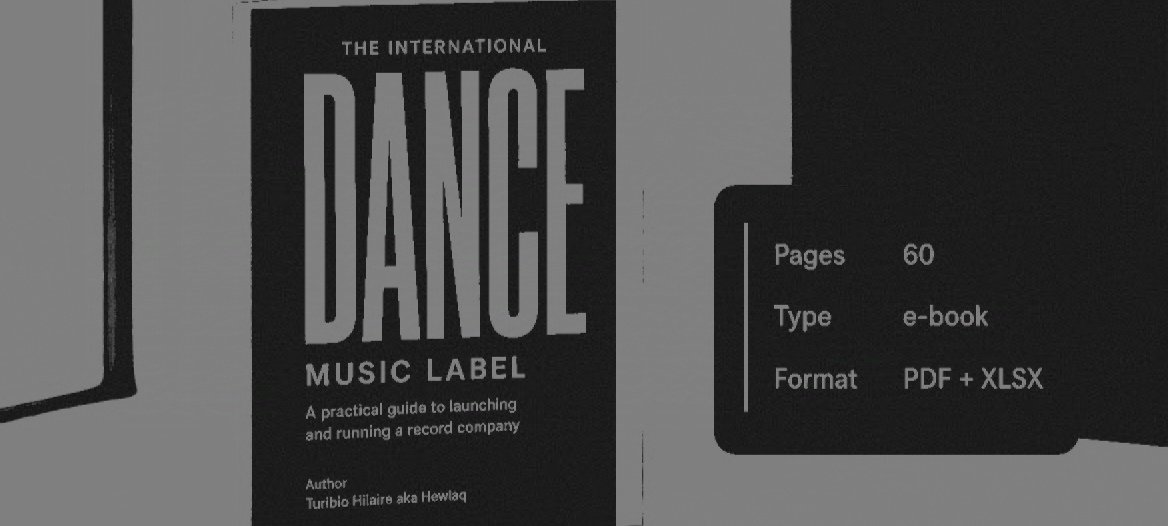
"The International Dance Music Label" is a 60-page working handbook for that stretch. E-book only, dedicated to EDM (Electronic Dance Music). Turibio Hilaire aka Hewlaq wrote it for founders starting from zero: the first company page, the first contract, the first master that has to hold up in a room, the first year that does not eat the second.
It is not a motivational book. It is the order of work. Taste and solvency sit at the front. Rights, files, A&R, delivery, money, and catalog come after, in the sequence you will meet them. Industry figures are dated and sourced. Where a number will move, the book says so.
You download two files: the handbook as PDF, and an advanced Excel workbook (XLSX) built for the same job. Artists, releases, metadata from the recording code through pitch date and street date, cash in, cash out, recoupment, and growth on each record and on the label as a whole. The sheets talk to each other. You type in the yellow cells. The rest recalculates.
If you want a costume and a loud week, this is the wrong file.
👉If you want a company you can still explain in twelve months, start here.👈
Sixty pages. E-book. PDF plus XLSX.
The handbook walks a new international dance label from a blank page to a catalog that can be accounted for. Early chapters cover what a label still is, the load of running one, how the electronic market is actually shaped, and how to write an identity short enough to reject music. Then the company itself: name and mark, legal form, payments, rooms and tools, files, public presence, and the habit of managing the week instead of reacting to it.
The middle of the book is the music operation
Finding a small first roster. Putting a deal in sentences a stranger could enforce. Keeping accounts from walking out the door. Finishing records so they translate. Planning a release with codes, credits, dates, and a pitch window that is not a guess. Moving music into stores. Registering the quiet income paths that sit beside streaming. Treating promotion as a sequence with a budget cap, not as a shopping list. Content, live work, rooms worth travelling to, and the extra products that only make sense after the catalog exists.
The last third is money and time
Cost stacks. Three honest budget sizes. When outside money is a loan against receipts and when it is a way to lose the catalog. Who to hire and when not to. A year mapped month by month. How to read growth without lying to yourself. How to keep the archive as a product. Closing pages on the first three artists, the first year, and what still matters when the novelty wears off. Checklists sit at the back so you can work from the book without rereading a chapter on a Tuesday night.
"The Excel file is not a decoration. It is the desk version of the same system. Roster and deal terms. One row per release with the metadata a store and a lawyer both need. A ledger for every receipt and invoice. Recoupment that shows what is still sitting against an artist and what is payable now. Monthly activity and growth on each title, then on the label. Change a split or log a cost and the dashboard moves."